Meat grinder and butcher tools on a workshop counter

Hunters & home butchers

Valley Sportsman Meat Processing Equipment for Hunters and Home Butchers

Thirty pounds of field-dressed venison hits your counter with the freezer clock already running, and Valley Sportsman's mixer, tenderizer, slicer, and grinder turn that pile into sausage, jerky, and burger before Sunday, rated 4.3★ across 294 verified buyer reviews. The grinder is the piece to size first: at 7 lbs a minute it sets the pace every other tool in the workflow has to match.

  • Clear a quartered shoulder through the #12 head in under five minutes, then move to the next chore
  • Blend a full 50-lb sausage batch on the hand crank, or bolt the mixer to the grinder motor and let it turn
  • Tenderize the backstrap first, swap the insert, and cut jerky strips on the same chassis

What ships in the box, on the record

  • Stainless blades and paddles Material named per machine, never blanket-claimed
  • Built-in circuit breaker Cuts grinder power before a jam reaches the windings
  • Fully detachable for cleaning Hand wash at the sink, plates and paddles lift off
  • 30-day return through the retailer No published warranty term, so test-fit on day one

Our meat processing equipment

One workflow end to end: the grinder sets the pace, and the 50-lb mixer runs off its motor when your arm gives out.

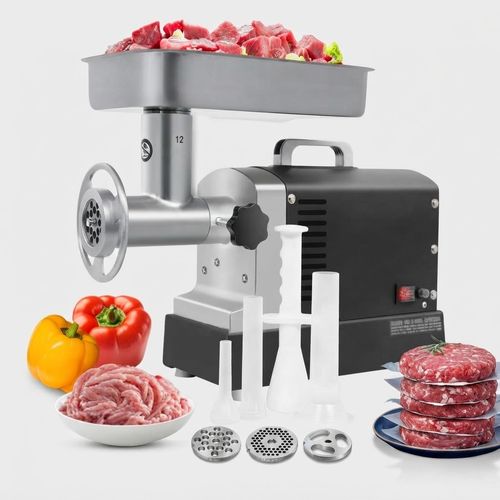
Commercial Electric Meat Grinder, #12 Head, 3/4 HP Flagship tier

Commercial Electric Meat Grinder, #12 Head, 3/4 HP

4.4 (24 verified reviews)

#12 head · 0.75 HP / 550W · rated 540 lbs/hour · 15″ x 15″ x 21″

Feed a quartered shoulder into the #12 head and the 0.75 HP motor clears it in minutes, at about 7 lbs a minute. Carbon-steel housing pulls heat off the motor during a long run, and a built-in breaker cuts power before a jam reaches the windings. Three plates and three stuffing tubes cover burger, coarse sausage, and casing work without a second purchase. Where hand-crank grinders of the past turned one deer into an afternoon, this turns the same pile into a break. Flagship tier, fully detachable for washing, with accessories stored in the drawer underneath.

  • Clears a rated 540 lbs an hour through the #12 head, about 7 lbs a minute
  • Carbon-steel housing sheds motor heat; a built-in breaker cuts power before a jam damages windings
  • Fully detachable for cleaning; test the auger seat inside the 30-day return window
Check price
Manual Meat Mixer, 50 lb / 7 Gallon Tilting Drum Upper-mid tier

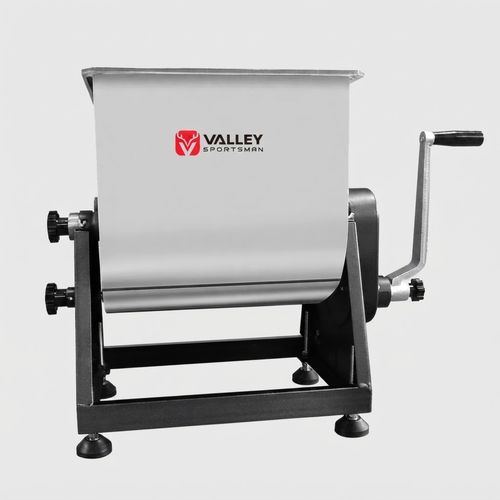
Manual Meat Mixer, 50 lb / 7 Gallon Tilting Drum

4.2 (70 verified reviews)

50 lb / 7 gal drum · stainless paddles · 35.1 lbs · 11.6″ x 14.4″ x 15.6″

Fifty pounds of venison and pork trim, water, and cure go into the 7-gallon drum in one load, and the crank turns them into an evenly seasoned batch without a second pass. Stainless paddles sweep the barrel wall as the shaft turns, so seasoning that settles at the bottom reaches the top of the load. Rubber feet hold the stand still on a wet counter. Where a standalone mixer asks you to buy its own motor, this one bolts onto the grinder's motor attachment when your arm gives out. Upper-mid tier, and the paddles pull off the shaft for hand-washing.

  • Loads 50 lbs (7 gallons) of trim and seasoning in one batch, then tilts out into the stuffer
  • Paddles sweep the barrel wall on every turn, so bottom seasoning reaches the top of the load
  • Paddles remove for hand-washing; a 30-day return through the retailer covers a damaged part
Check price
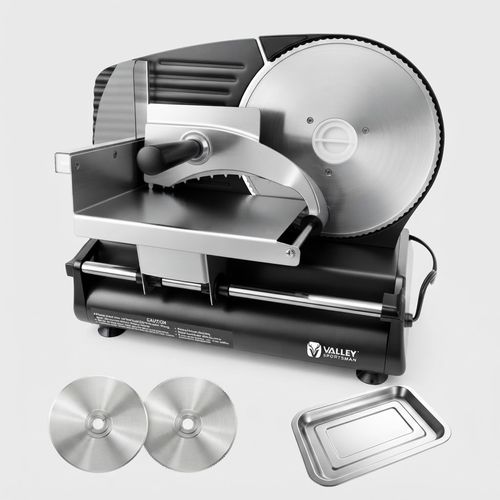
Electric Meat Slicer, 8.7-inch Dual Blades Mid tier

Electric Meat Slicer, 8.7-inch Dual Blades

4.3 (147 verified reviews)

180W motor · dual 8.7″ blades · 0–15mm dial · 12″ x 8″ x 5″

Turn one dial from 0 to 15mm and the same machine cuts paper-thin ham for a sandwich or bacon-thick planks for the smoker rack. A 180-watt motor holds blade speed under load, so a chilled roast parts cleanly instead of tearing at the edge. Two removable blades swap in: serrated for frozen meat, smooth for cheese and bread. Where a board and knife drift a millimeter a cut, the dial holds one thickness across a full jerky batch. Mid tier, with a fixed ring guard, a non-slip base, and hand-wash-only care.

  • Dual 8.7-inch stainless blades cut anywhere from 0 to 15mm on a single dial
  • 180-watt motor holds blade speed under load, so chilled meat parts instead of tearing
  • Rated 4.3★ by 147 verified buyers slicing jerky, deli meat, and bread
Check price
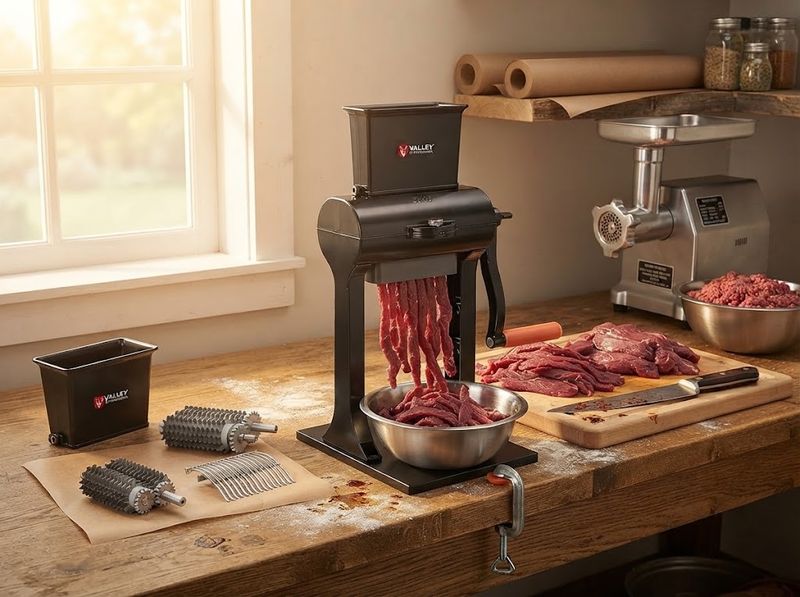
2-in-1 Meat Tenderizer and Jerky Slicer Entry tier

2-in-1 Meat Tenderizer and Jerky Slicer

4.3 (53 verified reviews)

16 tenderizing blade pairs · 31 slicing blades · aluminum body · 5″ x 10″ x 12″

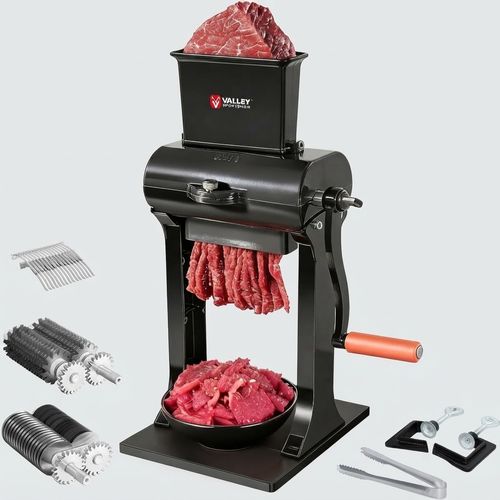
Crank a chilled backstrap through 16 stainless blade pairs and the fibers break down through the cut, where a mallet only bruises the surface. Paired blades score both faces at once, which is why a marinade reaches the center of a steak overnight instead of glazing the outside. Swap the insert and 31 slicing blades cut jerky strips off the same aluminum chassis. Where a separate tenderizer and a separate jerky slicer take two shelves and two cleanups, this holds one footprint. Entry tier, hand wash only, and the assembly wrenches ship in the box.

  • 16 tenderizing blade pairs and 31 jerky-slicing blades run through one chassis
  • Paired blades score both faces at once, so marinade reaches the center overnight
  • Replaces a separate tenderizer and a separate jerky slicer on the same shelf
Check price

What the Spec Sheet Actually Backs Up

Published figures back each one: 0.75 HP at the grinder motor, 16 tenderizing blade pairs, 50-lb mixer batches.

Measured at 540 Pounds an Hour, Not 'Powerful'

Feed quartered shoulder into the grinder head and the 0.75 HP motor clears a rated 540 lbs in an hour. That is a measured throughput figure, not an adjective.

Documented Material, Machine by Machine

Stainless body and paddles on the mixer, a carbon-steel housing on the grinder, an aluminum body with stainless blades on the tenderizer. Stated per machine, never blanket-claimed.

Stop Shopping for a Second Motor

Bolt the mixer onto the grinder's motor attachment and a single motor turns both machines. Toss the standalone-mixer-motor line item off your list before the season starts.

Picture the Whole Deer Done by Sunday Night

Grind Saturday's trim, mix a sausage batch, cut jerky strips Sunday, and keep the several-hundred-dollar per-animal processor fee in your own pocket.

Confirmed: 30 Days to Send It Back

No published warranty term exists for this equipment, so test-fit every part on day one. The 30-day return window through the retailer is the documented backstop.

Notice Where These Machines Already Sit

Look past a single online storefront: the same grinder and mixer stock across national farm, hardware, and outdoor retail channels, a detail most new labels cannot claim.

From Field to Freezer, Step by Step

The sequence runs mix, grind, stuff, slice, and the 550-watt grinder motor powers two of those four stations.

  1. Mix the Batch

    Load 50 lbs of trim, water, and seasoning into the 7-gallon drum and turn the crank.

  2. Grind and Stuff

    Fit the 4.5mm plate for burger, or the stuffing plate and 25mm tube for casings.

  3. Power Two Tools, One Motor

    Pull the grinder head, bolt the mixer on, and let the motor drive the paddles.

  4. Dial the Slice Thickness

    Turn the single dial anywhere from 0 to 15mm, deli-thin through bacon-thick.

The Jobs Each Machine Was Built Around

Each machine clears a different bottleneck: 540 lbs an hour grinding, 50-lb mixer batches, a 0-15mm slicing dial.

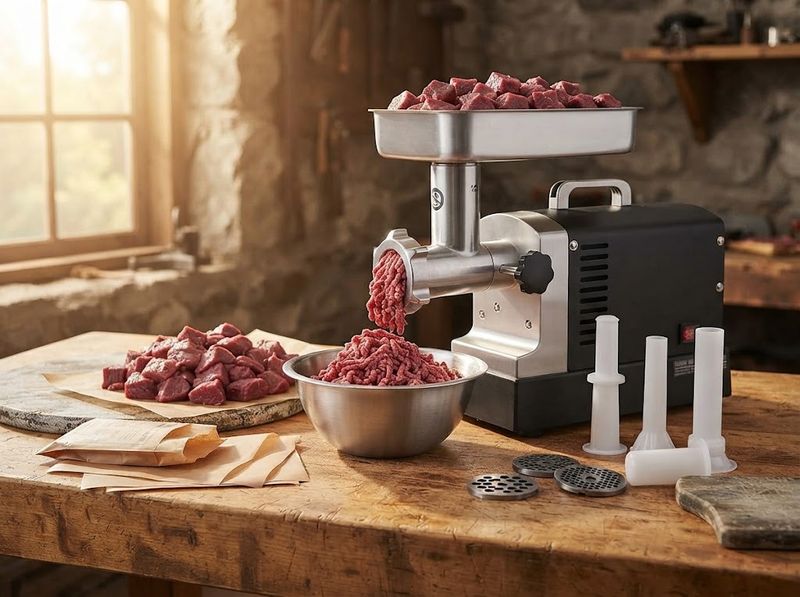
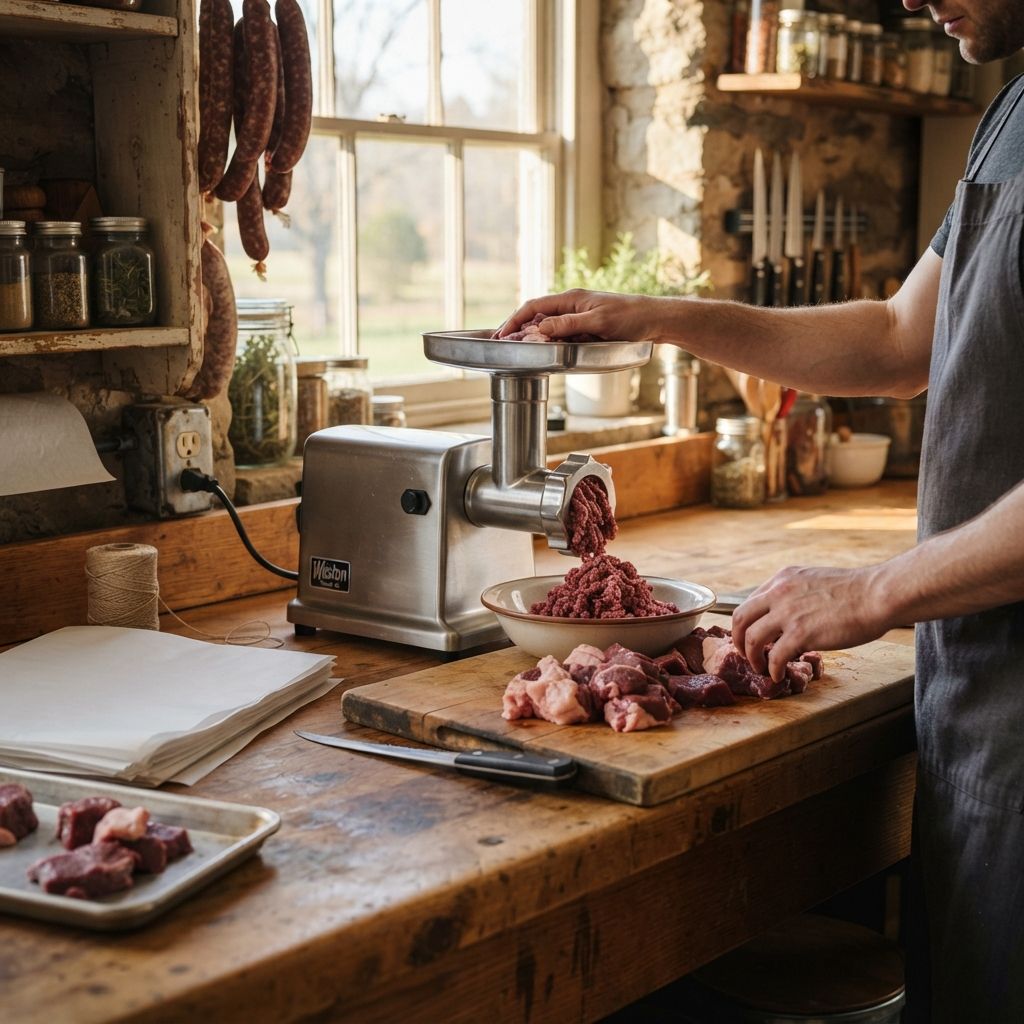
Commercial meat grinder feeding trim into a stainless pan

Clear a Full Shoulder Before the Next Chore Starts

The #12 grinder head takes quartered shoulder chunks at roughly 7 lbs a minute, which puts a rated 540 lbs through the 0.75 HP motor in an hour. Carbon-steel housing pulls heat off the motor during a long run, and a built-in breaker cuts power before a jam reaches the windings. Every part lifts off for washing at the sink.

  • Drop in the 4.5mm plate for burger grind, the 10mm for coarse sausage, and the stuffing plate when casings come out.
  • The carbon-steel housing sheds motor heat because steel conducts faster than a molded shell, so a two-hour session runs without a cooldown break.
  • Where hand-crank grinders of the past turned one deer into an afternoon, this one turns the same pile into a coffee break.
See the #12 grinder
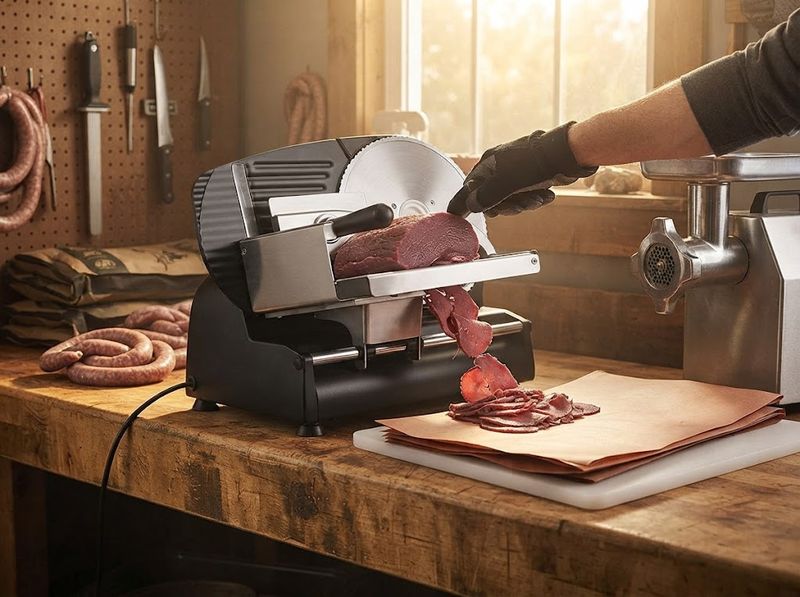
Electric meat slicer working through a chilled roast

Dial From Deli-Thin to Bacon-Thick Without Swapping Blades

One dial on the 180-watt slicer moves cut thickness from 0 to 15mm, so paper-thin ham and thick jerky planks come off the same 8.7-inch blade. Chill the roast for an hour first and the edge parts the fibers cleanly instead of dragging them. A fixed ring guard and a food pusher keep fingers away from the blade.

  • Turn the dial past 10mm and a venison roast comes off in bacon-thick planks ready for the smoker rack.
  • Two removable blades swap in place: the serrated edge bites frozen meat, the smooth edge handles cheese and bread.
  • Where a board and knife wander a millimeter per cut, the dial holds one thickness across a 15-lb jerky batch.
See the deli slicer
Meat tenderizer scoring a venison backstrap

Tenderize the Backstrap, Then Cut Jerky Strips on the Same Chassis

The tenderizer carries 16 stainless blade pairs for breaking down muscle fiber and a 31-blade insert for cutting jerky strips, both feeding through one aluminum chassis. Broken fiber lets a marinade reach the center of a cut instead of sitting on the surface, so an overnight soak seasons the meat through. Blades and body wash by hand at the sink.

  • Crank a chilled backstrap through the tenderizing pass, swap the insert, and run the same piece back through for strips.
  • Cube steak comes off the tenderizing pass because the paired blades score both faces of the cut at once.
  • Where a separate tenderizer and a separate jerky slicer eat two shelves, this holds one 5-by-10-inch footprint.
See the 2-in-1 tenderizer
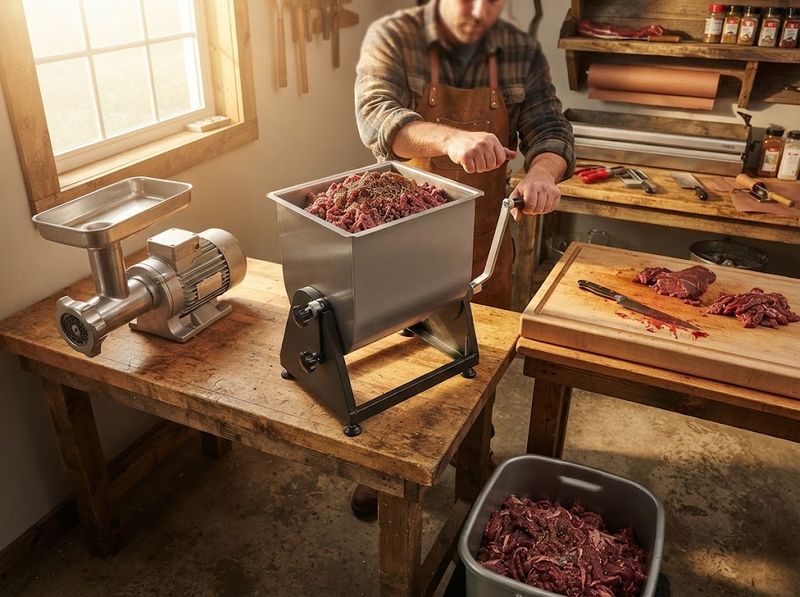
Meat mixer bolted to a grinder motor attachment

Skip the Second Motor You'd Otherwise Buy

The 50-lb mixer runs off its own hand crank or bolts onto the grinder's motor attachment, so a single motor drives both machines. Seven gallons of trim, water, and seasoning turn evenly in about the time a crank-only tub needs for half the load. Stainless paddles pull off the shaft for washing, and rubber feet hold the stand still on a wet counter.

  • Load venison and pork trim into the 7-gallon drum, then tilt the whole batch straight out into the stuffer.
  • At 35.1 lbs the mixer lifts onto a workbench solo, because the drum carries the load while the stand stays light.
  • Where a standalone mixer asks you to buy its own motor, this one borrows the grinder's between batches.
See the tilting-drum mixer

The Numbers Most Meat-Equipment Pages Skip

Throughput at 7 lbs a minute, plate sizes in millimeters, blade counts, dial range: measured figures where rival pages run adjectives.

7 lbs/min (540 lbs/hour)

Feed a quartered venison shoulder into the grinder head and the 0.75 HP motor clears it in under five minutes, at a rated 540 lbs an hour.

Grinder pages call the motor powerful without ever attaching a pounds-per-minute figure to it.

manufacturer spec

#12 head, 3 plates, 3 stuffing tubes

Drop in the 4.5mm plate for a fine burger grind, then thread on the 25mm tube when summer sausage casings come out. One head, no second purchase.

Head size gets named as a spec category elsewhere; the exact plate and tube sizes in the box rarely do.

manufacturer spec

16 blade pairs + 31 slicing blades

Run a trimmed backstrap through the 16 tenderizing blade pairs, then swap to the 31-blade insert for the strip-cutting pass on the same base.

Blade count appears as a category on rival pages, but the pair-and-blade split rarely gets published.

manufacturer spec

0-15mm dial range

Dial down for paper-thin deli slices, then turn past 10mm for a bacon-style cut, with no blade change between the two jobs.

Adjustable thickness gets named as a feature; the actual millimeter range rarely gets measured out.

manufacturer spec

35.1 lbs (15.94 kg)

Lift the mixer onto a workbench alone at 35.1 lbs, and the stainless paddle assembly still turns a full 50-lb batch without flexing.

Heavy-duty claims run across rival pages while the actual unit weight almost never appears.

manufacturer spec

4.3★ average / 294 verified reviews

Buyers who mix sausage batches and cut jerky season after season hold this equipment at 4.3★, averaged across 294 verified buyer reviews rather than a handful.

An aggregated, verified buyer-review count rarely appears on unbranded competitor pages.

294 verified buyer reviews

Valley Sportsman equipment on a home butchering bench

Built Around the Weekend After the Hunt

Valley Sportsman covers the whole home processing workflow: mixing, tenderizing, slicing, and grinding, with one motor doing double duty across two of the machines. One detail matters more than the star count: no published warranty term exists, so the return window is what actually protects you.

You buy the pieces you need, in the order your season demands. Start with the grinder if burger is the bottleneck, or the tenderizer if you make jerky and nothing else. Your kitchen decides the sequence, not a bundle someone else assembled.

A hunter working through a single deer each fall runs the trim over the grinder head, mixes a 50-lb sausage batch, and freezes the rest as steaks, where a per-animal processor fee used to take several hundred dollars out of that same season.

The machines stock across national farm, hardware, and outdoor retail channels, so you can put hands on one before you commit. Check the fit of every part in the first 30 days; a return through the retailer stays open that whole window.

Read the full story

What Buyers Reported After a Season

Rated 4.3★ across 294 verified buyer reviews, including the cleaning complaints.

★★★★★5.0

I went looking for another brand with the exact same specs and this one came in well under it, so I took the chance. First run I put 26 pounds of trim through and was done in minutes. It never bogged down, even feeding long thick strips. Full disassembly for cleaning is what sold me on keeping it. It ships with a 4.5mm and a 10mm plate; I would have liked a 6mm in the box too.

Dale W. Bozeman, MT Verified Purchase Commercial Meat Grinder
★★★★★5.0

Connected right up to my 1 HP grinder motor and saved a lot of sweat. I replaced a 30 pound manual crank mixer with this and ran about 100 pounds of sausage through it in three separate batches the first weekend. It comes apart quickly for cleanup, which matters when you are working cure into cold trim and want it off the metal fast. Solid build for what I paid.

Marcus T. Cody, WY Verified Purchase Manual Meat Mixer
★★★★★5.0

I bought this mainly for the jerky cutter and it works exactly the way I hoped. Letting the meat firm up in the freezer for an hour first makes a noticeably better cut. Assembly was straightforward and it breaks down easily at the sink. The strips come off even every time, which means the whole batch finishes in the dehydrator at the same moment instead of half of it going brittle.

Renee K. Bemidji, MN Verified Purchase Meat Tenderizer / Jerky Slicer
★★★★★5.0

It sliced up roasts for jerky very efficiently and it is light enough that I can carry it out of the pantry myself. Cleaning takes almost no time compared to what I expected. I also use it for sourdough, and it handles thick three-quarter-inch slices without tearing the crumb. For the money, this does more jobs than I bought it to do.

Gary P. Wausau, WI Verified Purchase Electric Meat Slicer
★★★★4.0

The cut quality is genuinely good and it handles the lunch meat volume I need without complaint. My one gripe is that it does not come fully apart, so cleaning around the blade takes patience and a careful hand if you are switching between raw meat and cheese. Chill everything firm first and it slices clean. Worth it for what I paid, with that caveat.

Sam D. Missoula, MT Verified Purchase Electric Meat Slicer
★★★★★5.0

My husband cut meat professionally for thirty years and owned his own shop. He bought this to do pork tenderloins at home now that he is retired and he loves the thing. It works, the cleanup is quick, and it takes almost no counter space. Coming from someone who used commercial equipment daily, that is not a small endorsement.

Tom H. Kalispell, MT Verified Purchase Meat Tenderizer / Jerky Slicer
★★★★4.0

Very well made and it does mate to a 1 HP grinder, which was the reason I picked it. It holds a lot and mixing venison and sausage is far better than doing it by hand in a tub. Cleaning is the honest downside; no mixer is easy there. Check the finish on yours when it arrives and use the return window if it is not what you expected.

Bill R. Rapid City, SD Verified Purchase Manual Meat Mixer
★★★★★5.0

This is a heavy-duty machine. It weighs a fair amount because of the steel in it, and it turns chunks that fit down the chute into burger without straining. I went from a stand mixer grinder attachment to this and it cut two hours off my processing time. If you want control over what actually goes into your ground meat, this is how you get it.

Josh M. Elkins, WV Verified Purchase Commercial Meat Grinder

Spec by Spec Against the Budget Tier

Published figures on the left, starting at 0.75 HP; on the right, what budget-tier competitors typically leave unstated.

CriterionValley SportsmanTypical alternativeCompared against
Motor power and throughput 0.75 HP / 550W, rated 540 lbs per hour (about 7 lbs per minute) Lower motor power; throughput rarely published at all Budget Grinders
Housing material Carbon-steel housing with stainless steel components Painted or molded plastic housings are common at this size Budget Grinders
Included accessories 3 plates (4.5mm, 10mm, stuffing), 3 stuffing tubes (15/25/35mm), onboard storage drawer Single plate, no onboard accessory storage Budget Grinders
Mixer power source Hand crank, or motorized off the grinder's motor attachment Separate dedicated motor purchase required Standalone Mixers
Tenderizing and jerky cutting 16 tenderizing blade pairs plus 31 slicing blades in one chassis Two separate machines, two footprints, two cleanups Single-Function Competitors
Slice thickness control Single dial, 0 to 15mm, dual 8.7-inch stainless blades Fixed or coarse-step thickness settings Budget Slicers
Buyer review aggregate 4.3★ weighted average, published verified review count Unverified or unpublished buyer ratings Unbranded Competitors

Day 1 to Season Three

Unboxing to the third hunting season, on one grinder motor, 16 blade pairs, and parts that all wash by hand.

  1. Day 1

    Day 1, unboxing: set the grinder on the counter, seat the auger into the motor before anything else, and dry-fit the mixer's paddle shaft. Anything that will not seat goes back inside the 30-day return window.

  2. Week 1

    Week 1, first batch: run 10 lbs of trim through the 10mm plate, taste the grind, then drop to the 4.5mm plate for the burger texture you actually wanted.

  3. Month 1

    Month 1, jerky rhythm: chill the backstrap, run the tenderizing pass, and the marinade reaches the middle of the strip overnight instead of glazing the outside.

  4. Season 2+

    Season 2 and beyond: stainless paddles and blades keep washing up by hand, and the grinder motor keeps doing double duty under the mixer every fall.

Ready for Day 1? Pick the machine your season actually needs, then compare the grinder and the mixer side by side.

What Buyers Worry About Before Ordering

Valley Sportsman buyers stall on the same worries before ordering: freezer clocks, processor fees, counter space, and doubt about the metal.

The Freezer Fills Faster Than You Can Process

Thirty pounds of field-dressed venison sits in the cooler and the clock starts the moment you hang it. Stop rationing kitchen time: the grinder head clears a quartered shoulder before the coffee goes cold, and the mixer takes the whole batch in one load.

50 lbs per mixer batch

Paying a Processor for Meat You Already Packed Out

A per-animal fee runs into several hundred dollars for game you tracked, shot, and carried out yourself. End that line item: grind, mix, and stuff at home, and the fee stays in your pocket every season after the first.

A Second Single-Task Tool Eating Counter Space

A tenderizer on one shelf and a jerky slicer on another means two boxes, two cleanups, two purchases. Toss the second machine: two blade sets swap into one chassis with a 5-by-10-inch footprint.

2 functions, 1 chassis

Wondering Whether the Metal Matches the Photo

Product photos flatten finish, and the word 'stainless' in a title tells you nothing about which part it covers. Strip away the guesswork machine by machine: the mixer's drum and paddles are the stainless pieces. The grinder's heat-shedding shell is carbon steel, with stainless plates, knife, and pan inside it. The tenderizer's chassis is aluminum, carrying stainless blades that score both faces of a cut.

A Part Arrives Damaged or Will Not Seat

An auger that will not drop into the motor, or a base plate whose holes will not line up, kills a processing weekend. Rip the box open the day it lands and test-fit every part: no published warranty term exists, so the 30-day return through the retailer is the protection that counts.

30-day return window

A 30-day return through the retailer covers a part that will not seat, so pick a machine and check its specs.

Why the Equipment Is Built This Way

Valley Sportsman builds around season throughput, materials stated per machine, repeat-season durability, and availability where hunters already shop.

Field-to-Freezer Throughput

The grinder is sized so one deer never becomes a two-day project. A season's worth of trim moves in an afternoon, not across a long weekend.

Materials Stated Per Machine

Stainless, carbon steel, and aluminum get named on the machine each belongs to. A blanket construction claim is exactly what buyers get burned by.

Built for Next Season, Not One Weekend

A permanently lubricated motor, a heat-shedding housing, and a built-in circuit breaker exist so the grinder starts again next November.

Stocked Where Hunters Already Shop

The machines reach farm, hardware, and outdoor retail channels nationally, so you can put hands on one in person before ordering.

Questions Buyers Ask Before Ordering

Throughput, materials, cleanup, and the return window, answered with published figures.

What does Valley Sportsman make?

Valley Sportsman builds meat-processing machines for hunters and home butchers: a 50-lb manual mixer, a 2-in-1 tenderizer and jerky slicer, an electric deli slicer, and a #12 commercial grinder. Together they cover the whole workflow from field-dressed trim to sausage, jerky, and ground burger, without sending anything to an outside processor. These are deer season meat processing tools sized for a home kitchen, not a butcher shop floor.

Is a home meat grinder worth it compared to paying a processor?

A per-animal processing fee runs into several hundred dollars and repeats every season you hunt. A single grinder covers that outlay within a few animals, and you keep the trim, the fat ratio, and the grind size under your own control. Hunters taking one deer a year usually break even faster than they expect.

Which machine should I buy first?

The grinder changes your timeline the most, so it comes first for anyone processing whole animals. If jerky is the main output and someone else grinds for you, start with the tenderizer instead: it sits at entry tier and it changes texture and flavor rather than speed. The mixer matters once batches pass 20 lbs.

Can a meat grinder help you use more of the animal?

Neck meat, rib trim, and shank scraps that get discarded on a cutting board turn into usable burger, sausage, or pet food once they run through a grinder. A single deer yields several extra pounds of edible meat that way. The 4.5mm plate handles finer grinds for sausage, the 10mm for coarse burger.

What's the difference between a meat mixer and a meat grinder?

A grinder cuts meat into ground texture through a plate; a mixer blends already-ground meat with water, cure, and seasoning so the flavor spreads evenly. Grinding alone leaves seasoning in pockets, which shows up as bland and salty bites in the same batch. Sausage-makers need both steps, in that order.

Is this equipment made for home use or commercial kitchens?

Sizing sits between the two. The grinder carries a #12 head and a 0.75 HP motor, which is heavier than most kitchen appliances but smaller than a butcher-shop floor unit. Home butchers, deer camps, and small delis all run this class of equipment on a standard household outlet. Expect batch-session duty rather than all-day continuous production.

How much meat can the grinder process in an hour?

The rated figure is 540 lbs per hour, which works out to roughly 7 lbs a minute through the #12 head. A quartered shoulder clears in under five minutes at that rate. Real-world throughput drops somewhat on very fatty trim, since fat feeds slower than lean muscle through any plate.

What grinder head size is this, and what does it mean?

This is a #12 head. The number describes the throat and plate diameter, which sets both the feed rate and which accessories fit. A #12 is the common step above kitchen-appliance grinders and suits one to three deer a season. Standard #12 plates and tubes from the accessory market generally match the same dimension.

What plates and stuffing tubes come in the box?

Three stainless plates ship with the grinder: 4.5mm for fine grind, 10mm for coarse, plus a stuffing plate. Three stuffing tubes cover 15mm, 25mm, and 35mm casings. A meat stomper, a stainless grinder knife, and a 12-by-8-inch stainless meat pan are included, and the drawer underneath stores all of it.

How much can the mixer hold in one batch?

Capacity is 50 lbs, or 7 gallons by volume, in a single load. That covers most of one deer's sausage in one session rather than three. The drum tilts with the lid on for emptying, and the removable stainless paddles come off the shaft afterward for washing. Fill it in place on the bench, since a loaded drum is awkward to carry.

Can I attach the mixer directly to a #12 meat grinder?

The mixer runs either way: hand crank, or driven off a grinder's motor attachment point. Owners commonly mount it to a #12-class grinder motor and let the motor turn the paddles through a full batch. Check the attachment geometry on your specific grinder before the first batch, and use the return window if the fit is wrong.

Still deciding? Compare the #12 grinder and the 50-lb mixer side by side in the specs above.